
At BIOTREX, we help agricultural professionals make the invisible work of microbes visible through functional indicators – quantitative measures of microbial activity related to key soil processes. One of these is the Decomposition Potentialindicator, which assesses the microbial community’s potential to break down organic matter.
This article explains why microbial decomposition matters in agriculture, how we measure it, what insights the Decomposition Potential indicator offers, and how it can guide management decisions in fields, trials, and research programs.
Why Microbial Decomposition Matters in Agriculture
Microbial decomposition is one of the most fundamental biological processes in soil. During decomposition, soil microorganisms break down organic matter (such as crop residues, root exudates, compost or manure) into simpler compounds. Microbial decomposers, primarily bacteria and fungi, convert these materials into nutrients available to plants and into stable soil organic matter that builds long-term fertility.
Microbial decomposition supports crucial ecosystem services in each soil and every farming approach:
- Nutrient cycling: Microbes release nitrogen, phosphorus, sulfur, and other nutrients from organic compounds, making them available to plants.
- Soil structure and stability: Decompositon of organic matter contributes to the formation of stable soil organic matter and soil aggregates, improving soil fertility, water retention and aeration.
- Carbon cycling: Microbial decomposition plays important role in carbon cycling in the environment. Soil microorganisms transform carbon from organic residues into microbial biomass, CO₂, and stable organic matter that can stay in the soil for long time.
Without active microbial community, decomposition of organic matter slows down, leading to limited nutrients turnover, inefficient use of organic input, and increased dependence on mineral fertilisation. Whether in regenerative, organic, or conventional agriculture, supporting microbial decomposition is key to productivity and long-term fertility.
How BIOTREX Measures Decomposition Potential
BIOTREX uses a method called Community-Level Physiological Profiling (CLPP) to evaluate the activity and functional diversity of soil microbial communities. In contrast to genetic or taxonomic analyses, CLPP focuses on function – not who is there, but what they are capable of doing.
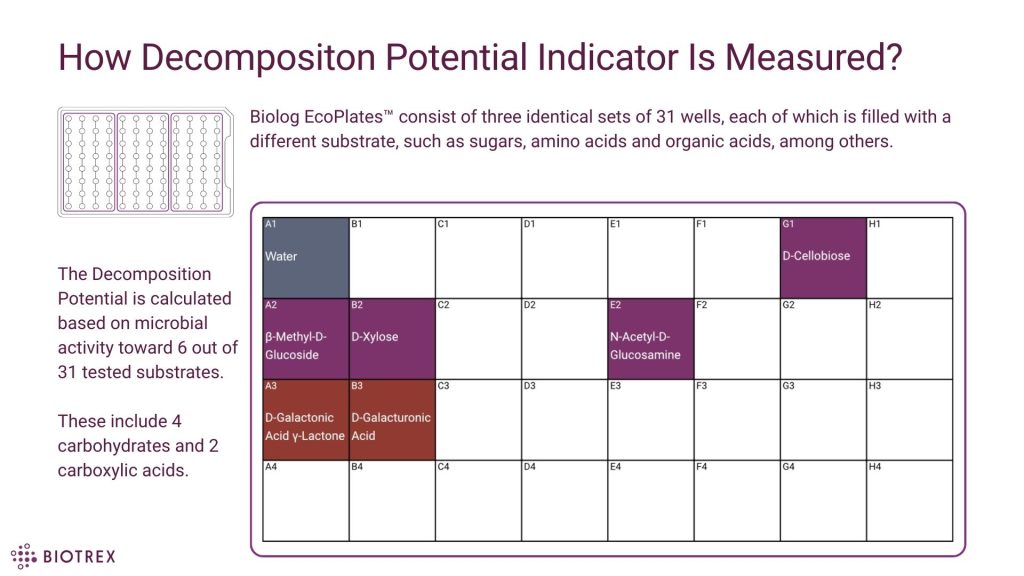
The method works a bit like offering a buffet to the microbes extracted from soil sample. Here in BIOTREX, we use Biolog EcoPlates™, which contain 31 wells, each filled with a different substrate — sugars, amino acids, organic acids and other compounds that microbes might encounter in real soil environments. These carbon sources serve as food options.
The process begins with a soil sample taken from the field. The living microbes in that sample are then extracted and exposed in laboratory conditions to substrates on the EcoPlate™. The speed and intensity with which the microbial community utilises these substrates are measured using a colorimetric assay (meaning we observe the colour change over the time). The stronger and faster the colour change, the more active the microbial community.
The Decomposition Potential indicator is based on the microbial community’s metabolic activity when exposed to a standardised panel of substrates related to plant-derived polymers and other organic compounds. The higher the activity toward those specific carbon sources, the higher the Decomposition Potential score.
What Substrates Are Used to Calculate Decomposition Indicator?
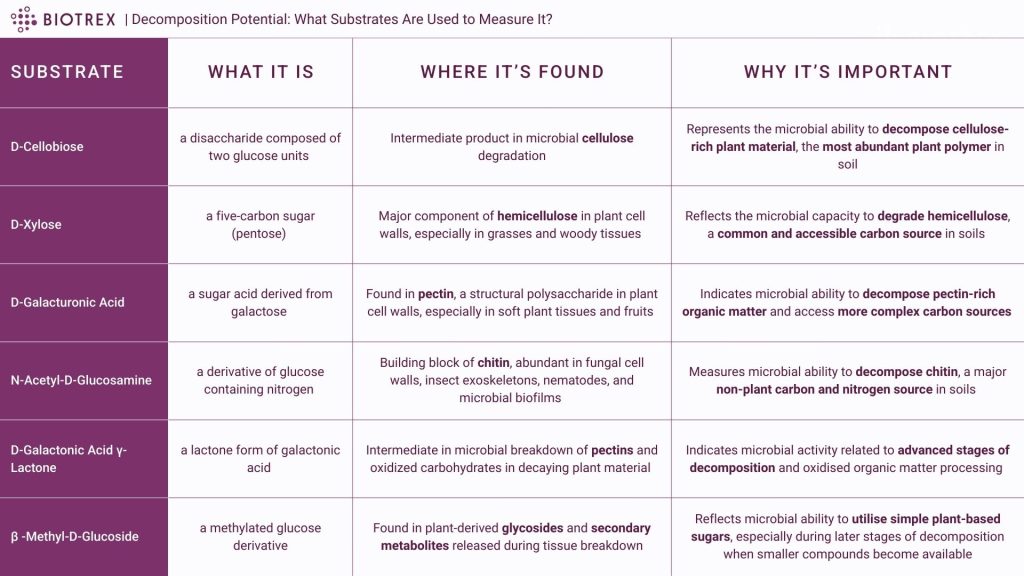
Each of the substrates used to calculate the Decomposition Potential plays a specific role in microbial decomposition and provides insight into microbial activity related to carbon cycling in soil.
These substrates were chosen because they:
- Represent common components of organic matter in soils.
- Are accessible to a broad range of soil microbes.
- Reflect different stages and pathways of decomposition, including cellulose, hemicellulose, pectin, and chitin breakdown.
What the Decomposition Indicator Tells Us
What’s important to understand, BIOTREX analysis results reflect the state of the soil microbial community at the time of sampling.
The Decomposition Potential indicator reflects the potential of microbial community to break down various sources of organic matter in the soil. While it doesn’t directly measure how much organic matter is decomposing in the field, it gives valuable insight into the capacity of the soil microorganisms to perform this role, based on the current state of the microbial community. This makes it a practical and insightful metric for field trials, soil monitoring, and product evaluation.
Who Can Benefit from Measuring Decomposition Potential?
If you’re looking for a tool to help you understand and improve soil function, including the Decomposition Potential in your assessment will definitely benefit you.
The Decomposition Potential indicator reveals how capable the soil microbial community is at breaking down organic matter, a key step in turning crop residues, compost, or cover crops into plant-available nutrients and stable organic carbon. It’s a tool that makes invisible microbial processes visible and actionable.
Who benefits from measuring the Decomposition Potential?
Producers of biostimulants and microbial inoculants
- Use clear data to demonstrate product value and mode of action,
- Strengthen communication with growers and distributors.
R&D teams
- Evaluate whether products improve decomposition potential in trials,
- Compare doses, application strategies, or product combinations.
Agronomists and consultants
- Diagnose whether soil biology supports residue breakdown and organic matter formation,
- Recommend targeted, biology-informed management practices.
Farmers and growers
- Identify biological limitations in underperforming fields,
- Make more informed decisions to support long-term soil fertility and resilience.
When you’re managing soil as a living system, knowing its decomposition potential brings you closer to making decisions that support long-term fertility, productivity, and resilience.
What Does a Low Decomposition Score Mean and What Can You Do About It?
A low Decomposition Potential score indicates that the soil microbial community currently has limited capacity to break down organic matter.
This may be due to factors like reduced microbial diversity, lack of fresh organic inputs, or environmental stress such as drought or low pH. Some organic materials, like straw or woody residues, also decompose more slowly due to their complex structure.
The consequences of inefficient decomposition can be felt across the soil ecosystem. Nutrients remain locked inside organic materials, making compost, manure, and cover crops less effective. Without active decomposers, the formation of stable organic matter slows down, weakening the soil’s ability to store carbon, retain water, and build long-term fertility. A soil with low biological activity is also more vulnerable to diseases and environmental stress, as it lacks the resilience of a well-functioning microbial community.
Fortunately, microbial decomposition is something you can support. Although there’s no one-size-fits-all solution, there are many effective practices to choose from. Even small changes, applied consistently, can lead to significant long-term improvements in soil function.
- Feed the microbes: Apply a diversity of organic inputs, such as crop residues, composts, manures and green manures, to support different microbial groups.
- Keep the soil covered: Use cover crops or intercropping to maintain living roots and stimulate microbial activity.
- Minimise disturbance: Reduce tillage to protect fungal networks and microbial habitats.
- Use microbial inoculants: Specialised microorganisms can support specific soil functions, if matched with soil need.
While improvements may take time, even small changes can lead to measurable results within a season or two. With functional indicators like the Decomposition Potential, you can track progress and adjust your strategy with confidence.
For a deeper understanding of what drives microbial decomposition, and practical ways to support it, read our previous article Microbial Decomposition: The Soil Process That Makes Everything Work.
Microbial decomposition is a cornerstone of soil health and fertility. With the BIOTREX Decomposition Potential indicator, we can measure the potential of soil microbial communities to perform this essential role.
BIOTREX’s functional indicators provide unique insight into what’s happening in the soil. To learn more about how BIOTREX can support your work, get in touch with our team today.
Ready to explore how BIOTREX can support your goals?
Book a free call with our experts and discover the impact microbial data can have on your business.