
How Soil Biology Impacts Field Trial Outcomes
Microbial inoculants and biostimulants are designed to function within the existing environment of a given field. However, soil is already a biologically active and diverse ecosystem, shaped by its native microbial community, previous management practices, and current levels of biological activity.
When a microbial product is introduced, it must compete, integrate, and function within this complex system. As a result, the same product, applied at the same rate and timing, may generate clear positive effects in one field and show little or no measurable response in another. Its success depends on whether it can find an open niche within a crowded microbial ecosystem and whether the soil is truly lacking the function it is designed to enhance.
In this article, we focus specifically on these soil biological factors and explain how understanding microbial activity, assessed through soil tests such as BIOTREX soil microbial analysis based on Community-Level Physiological Profiling (CLPP), can help interpret product trial outcomes more accurately. By measuring how the soil microbial community utilises a range of carbon substrates, CLPP provides insight into overall microbial metabolic activity and functional diversity before and after product application.
Competition with Native Microbial Community
One of the most common reasons inoculated strains do not produce measurable effects is competition with native soil microorganisms.
Native soil microorganisms are typically well adapted to local conditions and have established access to available resources. In soils with high microbial diversity and activity, introduced strains may struggle to compete for nutrients or to establish a stable functional role within the existing microbial community. As a result, they may remain metabolically dormant or not survive at all.
This often means that overall microbial activity shows little or no change. If the introduced microorganisms are unable to survive or grow under field conditions, their metabolism remains dormant or only weakly active. Because BIOTREX assesses the metabolic activity of the living microbial community, no measurable difference will be detected when introduced strains fail to become metabolically active.

High Basal Activity and Limited Room for Improvement
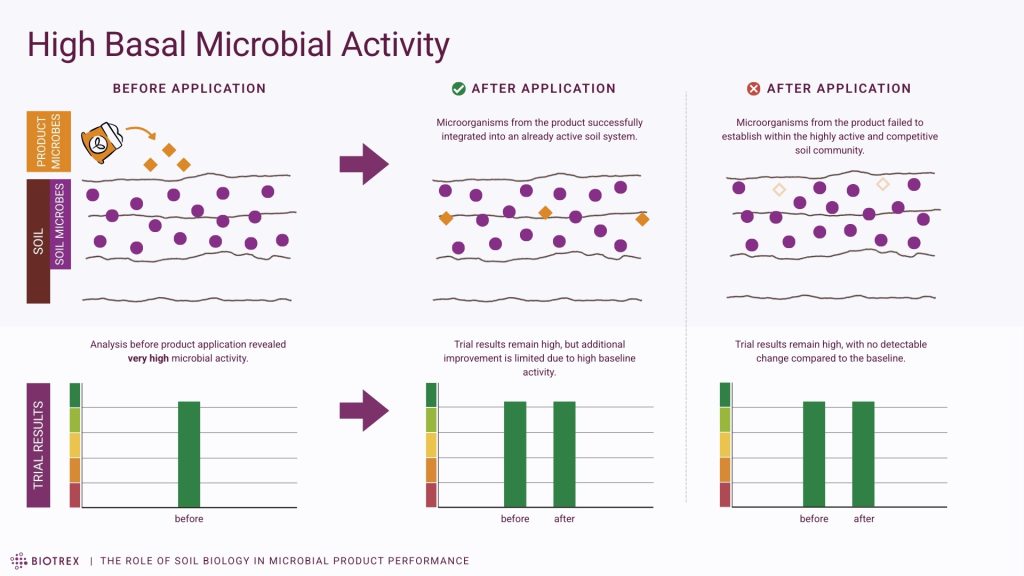
In some fields, soil microbial activity and diversity are already high, indicating a well-functioning biological system. These soils often show strong decomposition processes, efficient nutrient cycling, and a high degree of functional redundancy within the microbial community (meaning that key soil functions are supported by many different microorganisms, allowing the soil to remain stable under stress and to recover quickly after disturbances).
Under these conditions, introduced microorganisms may fail to survive or establish. But they may also integrate successfully into the existing microbial community. In trials results, both outcomes can produce similar results, as microbial activity indicators, such as CLPP, have limited capacity to detect further increases when baseline metabolic activity is already elevated.
Selecting biologically well-functioning soils for product trials can therefore make it inherently difficult to demonstrate added value, even when inoculated microorganisms are compatible with the native community and highly active.
Co-application with Compost and Organic Amendments
Microbial inoculants are often applied together with compost or other organic amendments, with the intention of supporting survival and activity of introduced microbial strains. Especially compost is commonly seen as a valuable source of carbon, nutrients, and microbial life, and its use alongside inoculants is intended to support introduced microorganisms by improving substrate availability and overall biological activity in the soil.
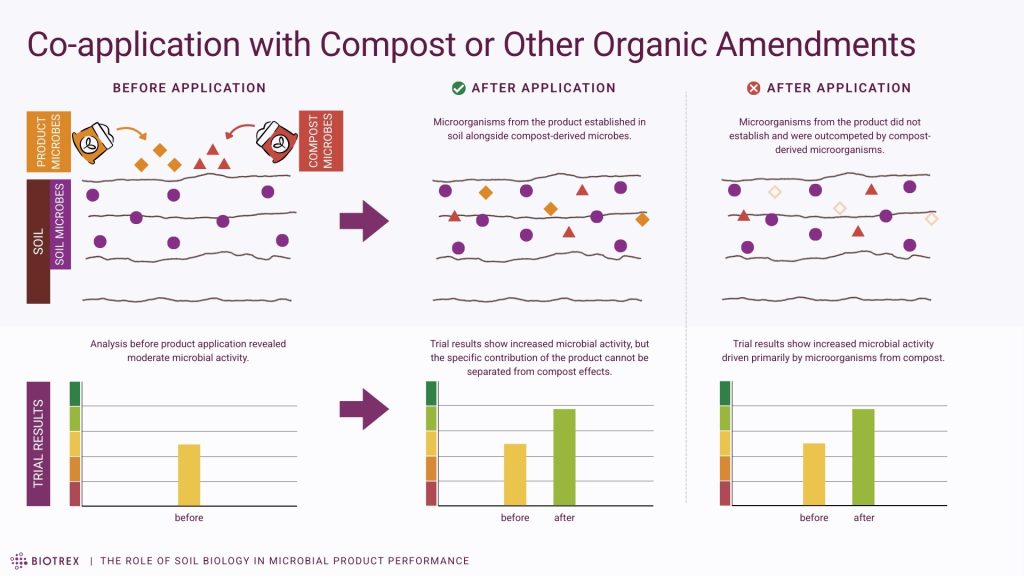
In practice, this combination can lead to two different outcomes that make it difficult to detect the effect of the product.
First, compost introduces its own microorganisms that are highly adapted to environments rich in readily available organic substrates. These microorganisms can rapidly utilise the carbon sources provided by the compost, often outcompeting introduced strains that are less specialised for such substrate-rich conditions and limiting their ability to establish or remain active.
Second, compost-derived microorganisms are typically highly active and fast growing, which can result in a strong increase in overall microbial activity shortly after application. This elevated background activity may mask the contribution of the inoculated microorganisms, making it difficult to distinguish their specific effect, even if they are present and functionally active in the soil.
How to Reduce Soil Biology Related Risks in Product Trials
Field conditions introduce biological variability that cannot be standardised in the same way as laboratory environments. However, thoughtful trial design can account for this variability. The following principles help ensure that soil biological factors are considered systematically and that trial results reflect product performance rather than background noise.
- Assess the biological baseline before application.
Measure soil microbial activity and diversity before introducing the product. Determine whether the soil is biologically limited, balanced, or already highly active. When baseline activity is high, the potential for measurable improvement may be limited, even if the product is biologically compatible. - Monitor changes over time.
Do not rely on a single post-application measurement. Microbial responses can be immediate, delayed, or temporary. Multiple sampling points allow you to capture these dynamics and avoid premature conclusions. - Separate product effects from other biological inputs.
When compost or other organic amendments are applied together with a microbial product, their biological contribution may mask or override product-specific effects. If co-application is necessary, include an additional compost-only treatment to distinguish between compost-driven and inoculant-driven responses. - Select fields with realistic improvement potential.
Fields with lower or moderate biological activity provide better conditions for demonstrating measurable product effects. In highly active soils, microbial diversity is often high, which can limit the establishment of introduced strains. In addition, when baseline activity is already elevated, the resolution of soil tests may not allow further improvements to be detected. - Complement activity-based measurements with DNA-based analysis when needed.
Activity-based methods, such as CLPP used in BIOTREX soil microbial analysis, indicate changes in microbial functioning but do not capture shifts in community composition. DNA-based analysis can reveal whether the structure of the microbial community changes after product application. In trials where establishment, persistence, or community shifts are important, combining both approaches provides a more complete picture.
Turning Variability into Strategic Advantage
When microorganisms from a product are introduced into a field, they immediately encounter an established and active soil community. Their survival and performance depend not only on product quality, but on their ability to compete with native microorganisms, integrate into existing processes, and contribute to functions that are not already sufficiently supported.
Tools such as BIOTREX make soil biology visible and allow it to be incorporated directly into trial design and interpretation. This changes the way microbiological products are evaluated — from simply observing whether an effect appears to understanding how existing soil biology shapes the outcome. Instead of relying on general assumptions, producers can design trials around field-specific biological conditions.
As a result, the focus moves toward understanding where, when, and under what conditions a product performs best. Trials that do not show a measurable effect are no longer seen as failures, but as sources of insight — enhancing product credibility and strengthening communication with growers.
At the same time, soil biology represents only one dimension of field trial variability. Environmental conditions, including temperature, moisture, and soil physicochemical properties, further influence whether introduced microorganisms can survive, establish, and express their function. In the next article, we will examine how these environmental factors shape product performance in real field conditions.
Ready to explore how BIOTREX can support your goals?
Book a free call with our experts and discover the impact microbial data can have on your business.