
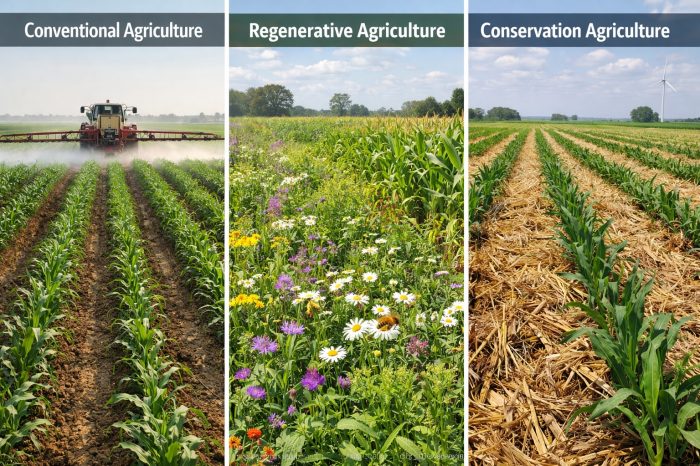
Understanding how different farming practices affect soil life is essential for anyone developing biological or regenerative solutions. Soil microorganisms play a key role in many soil processes – from nutrient cycling and carbon sequestration to disease suppression and plant growth. Without understanding their response, it’s impossible to fully assess whether a product or practice truly supports long-term soil health and fertility.
Yet, assessing soil microbial activity often feels impractical. Many companies has experience with microbial analysis being expensive, time-consuming, and difficult to interpret.
This case study, based on a trial conducted by the Royal Norwegian Society for Development (Norges Vel), demonstrates how BIOTREX soil microbial analysis can simplify and streamline the process. By comparing conventional, Conservation Agriculture, and regenerative fields, this article demonstrates how easily you can obtain fast, clear, and comparable insight into soil biological functioning.
This article demonstrates how easily you can obtain fast, clear and comparable insight into soil biological functioning by comparing conventional, regenerative, and Conservation Agriculture.
The Challenge of Measuring Soil Biology
Field trials are the backbone of product validation and sustainable practices development. They provide proof of concept, quantify performance, and guide future recommendations.
However, obtaining reliable biological data is not easy. Setting up an in-house microbiology laboratory is rarely an option – it requires major investment, specialized equipment, and expert staff.
There are many methods available to study soil biology – each offering unique insights but varying greatly in cost, complexity, and interpretability. Choosing the right approach depends on the goal of the trial, available expertise, and how the results will be applied in practice.
As a result, many organizations face a frustrating gap: they recognize the importance of soil biology but lack a method that is both scientifically meaningful and practical for routine use in field trials.
Not Sure About Soil Biology Testing?
Discover how it can support better decisions, reduce uncertainty, and bring real value to your work.
BIOTREX: Practical Approach to Soil Microbial Analysis
BIOTREX uses the Community-Level Physiological Profiling (CLPP) approach based on the Biolog EcoPlate™ method to assess what soil microbes do, not just who they are. Instead of sequencing DNA, CLPP measures the ability of living soil microbial community to metabolise different carbon sources – a direct indicator of their activity, adaptability, and functional diversity.
DNA-based methods, such as shotgun sequencing, provide detailed information about which microorganisms are present in the soil. The CLPP approach used by BIOTREX, in turn, shows what these microorganisms are doing – how active and functionally diverse they are.
At BIOTREX, this research-proven technique has been fully standardised for agricultural use, ensuring consistent, comparable, and easy-to-interpret results. It provides a practical way to monitor how soil biology responds to management changes – from tillage reduction to organic inputs – and supports data-driven decisions for healthier, more resilient soils.
The Experiment: Conservation Agriculture, Regenerative Agriculture, and Conventional
The results presented in this study are based on a trial conducted at Hellerud Farm, a research site located in Norway. As part of their ongoing trials, Norges Vel carries out a variety of soil analyses to evaluate the impact of different management strategies on soil quality and fertility.
Among these, BIOTREX microbial analysis was used to assess microbial activity and functional diversity, providing insight into how soil life responds under three contrasting farming systems: conventional agriculture (treated as control field), Conservation Agriculture, and regenerative agriculture.
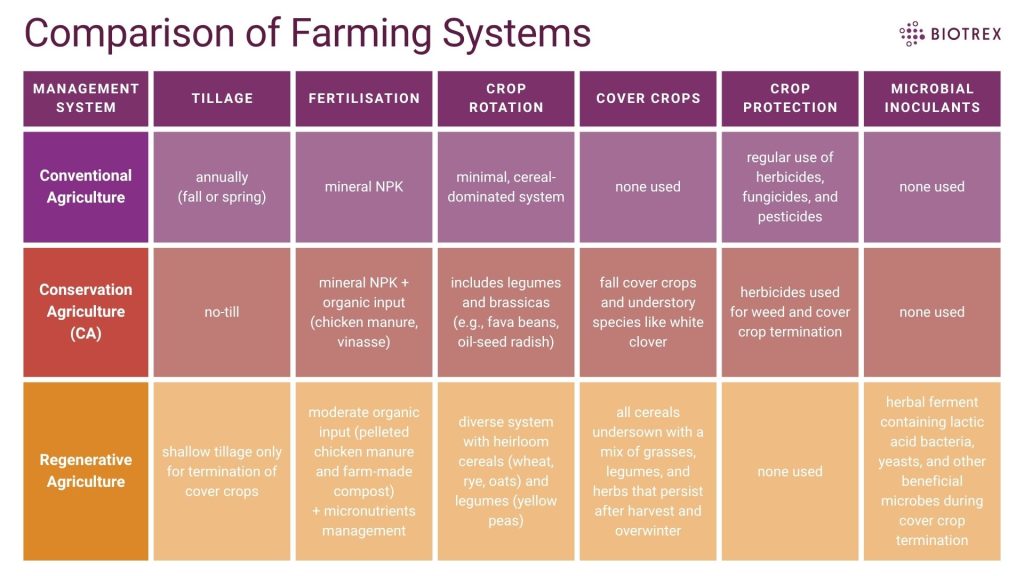
Conventional farming
Standard Norwegian small grain production – representing the baseline for comparison.
Tillage: Fall or spring tillage performed annually.
Fertilisation: Synthetic fertilisers applied at ~120–150 kg N/ha; phosphorus (P) and potassium (K) adjusted based on soil testing every five years.
Crop rotation: Minimal or no crop rotation; cereal-dominated system.
Cover crops: None used.
Crop protection: Regular use of herbicides, fungicides, and pesticides.
Conservational Agriculture
Strict no-till system emphasising soil cover and crop diversification.
Tillage: No-till; soil left undisturbed between crops.
Fertilisation: Primarily mineral fertilisers, supplemented with organic materials such as pelleted chicken manure or vinasse (a potassium-rich byproduct from the sugar industry).
Crop rotation: Includes legumes and brassicas (e.g., fava beans, oil-seed radish); currently annuals, with future integration of perennials planned.
Cover crops: Use of fall cover crops and understory species like white clover to maintain soil cover and reduce erosion.
Crop protection: Herbicides used for weed and cover crop termination.
Regenerative Farming
Regenerative approach inspired by the work of Gary Zimmer, Neal Kinsey, and John Kempf.
Tillage: Minimal disturbance; shallow tillage used only for cover crop termination.
Fertilisation: Moderate organic inputs – pelleted chicken manure (50 kg N/ha) and farm-made compost (5 t/ha).
Micronutrient management: Targeted additions of calcium, boron, sulfur, etc., guided by base cation saturation analysis to optimize soil fertility and pH buffering capacity.
Crop rotation: Diverse system with heirloom cereals (wheat, rye, oats) and legumes (yellow peas); future inclusion of a two-year herbal ley for grazing or cutting.
Cover crops and understory: All cereals undersown with a mix of grasses, legumes, and herbs that persist after harvest and overwinter.
Bioinoculants: Use of herbal ferment (EM bioinoculant) containing lactic acid bacteria, yeasts, and other beneficial microbes during cover crop termination.
Foliar nutrition: Guided by plant sap analysis (NovaCropControl); applications of foliar sprays enriched with compost extract, molasses, and seaweed.
Soil samples from each system were analysed using the BIOTREX CLPP method to determine how management intensity translates into activity and functional diversity of soil microbial community.
How Soil Life Responds to Different Farming Systems
From the first inquiry from Norges Vel to receiving the complete BIOTREX Report, the entire process took only two weeks. The turnaround time from courier pickup of the soil samples to the start of the analysis in our laboratory was seven days, which was slightly longer than usual due to customs procedures for soil samples shipped from outside the European Union. Despite this delay, the results were ready well within a practical timeframe for field trial evaluation.
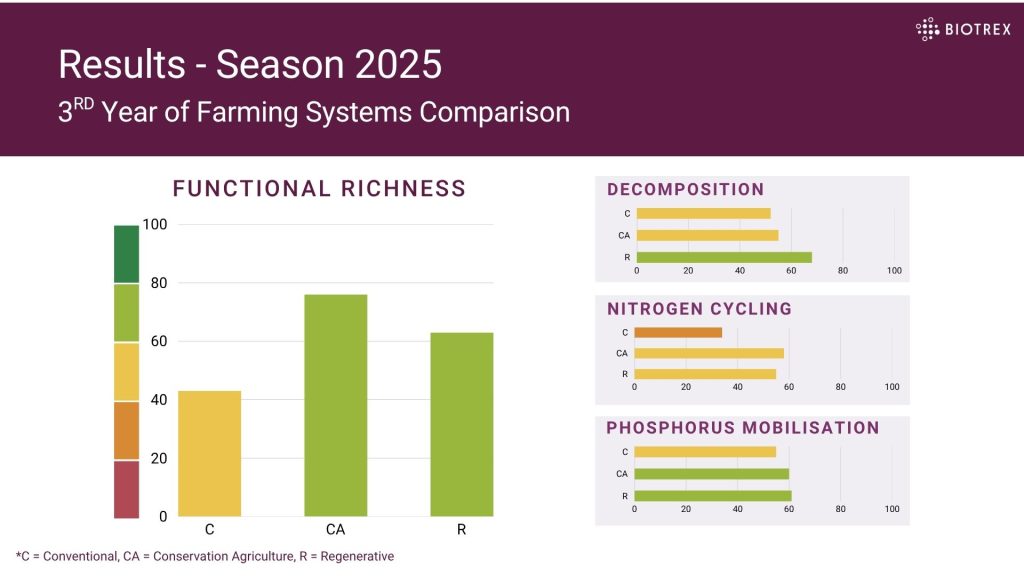
Soil samples collected in September 2025 showed distinct differences between the three field management systems. The Summary page at the start of the BIOTREX Report lets you quickly see the results and compare them across different treatments.
Both the Conservation Agriculture and regenerative agriculture fields showed substantial improvement in microbial activity and functional indicators compared with the conventional baseline.
Microbial Performance – summarising microbial activity and diversity – was highest in the regenerative agriculture field, followed by the Conservation Agriculture field, with the conventional agriculture field remaining lowest.
Microbial Biodiversity, which is defined as the diversity of functions provided by the soil microbial community, remained moderate across all farming systems.
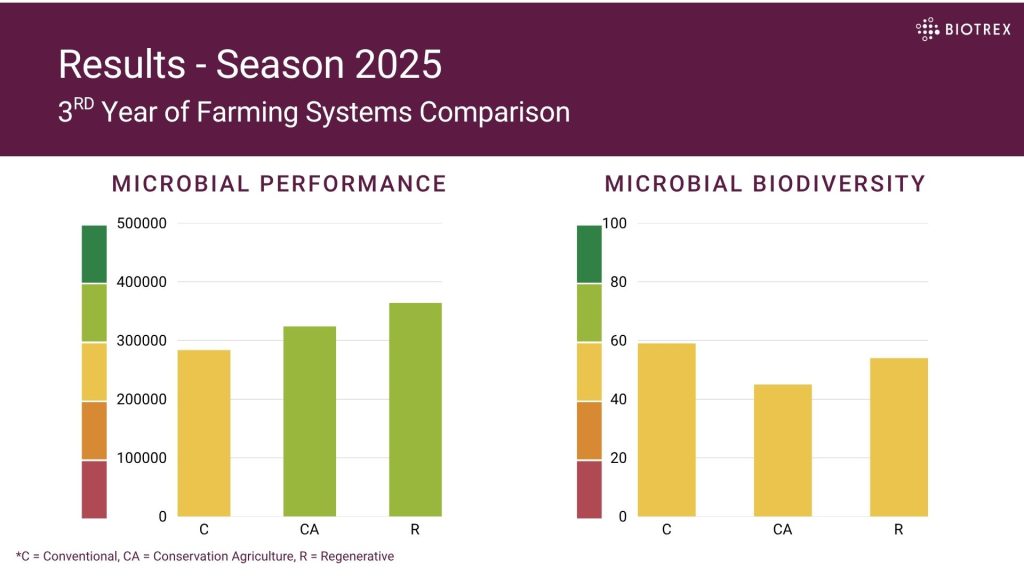
Functional Richness reflects the agronomic potential of the soil – the ability of microbial community to utilize a wide range of organic compounds. Higher Functional Richness, as observed in the Conservation Agriculture and regenerative agriculture fields, indicates that the microbial community can access and metabolize a broader spectrum of substrates.
Process-related indicators such as Decomposition, Nitrogen Cycling, and Phosphorus Mobilisation also increased markedly in the Conservation Agriculture and regenerative systems, confirming that changes in management practices translate directly into stronger biological function. This results in more efficient decomposition and nutrient turnover, supporting soil fertility and crop performance.
Based on our experience, we would say that the improvements seen in the Norges Vel trial are probably due to four significant changes in field management:
- Reduced tillage, which limits disturbance and preserves microbial habitats.
- Cover crops, maintaining living roots that support activity of microbes.
- Organic fertilisation, providing diverse and bioavailable energy sources for microbes.
- Crop rotation, fostering more diverse and balanced microbial communities.
Together, these practices create a more active and functional soil ecosystem, where microorganisms contribute actively to nutrient cycling and organic matter turnover.
From Soil Life to Field Results
See how Conservation Agriculture translates into measurable gains, not just in soil microbial activity, but also in yield and input costs.
Soil Monitoring: Year-to-Year Comparison
Norges Vel conducts annual monitoring of the same fields, allowing long-term trends to be observed and interpreted in context.
When comparing data from 2024 and 2025, Microbial Performance increased by 18% in the Conservation Agriculture field and by over 50% in the regenerative agriculture field compared with the previous year. Meanwhile, the conventional agriculture field showed a modest increase of just 4%.
However, Microbial Biodiversity showed a more complex pattern. Over the year, Microbial Biodiversity increased by 31% in the conventional agriculture field and 26% in the regenerative agriculture field, while remaining unchanged in the Conservation Agriculture system.
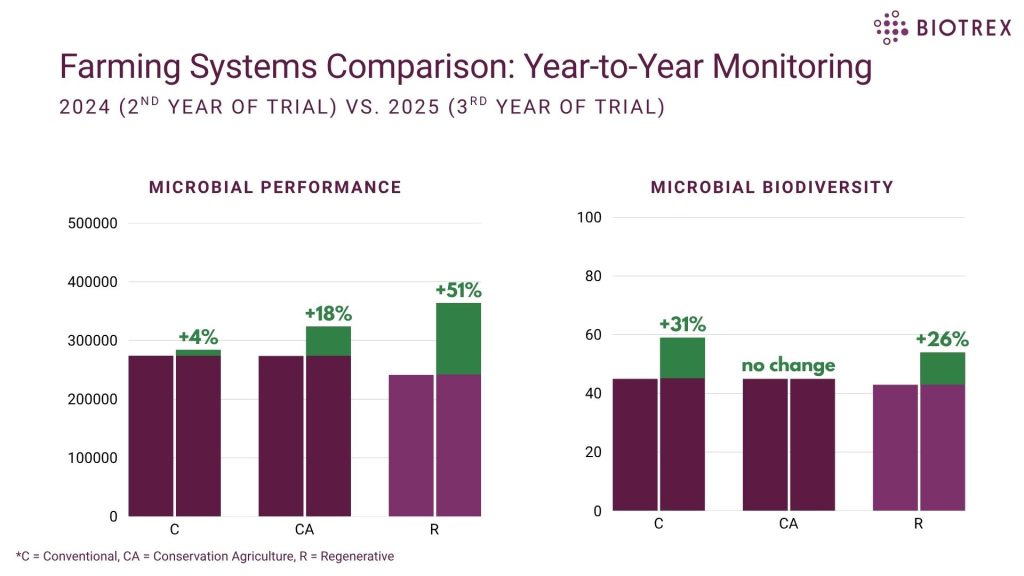
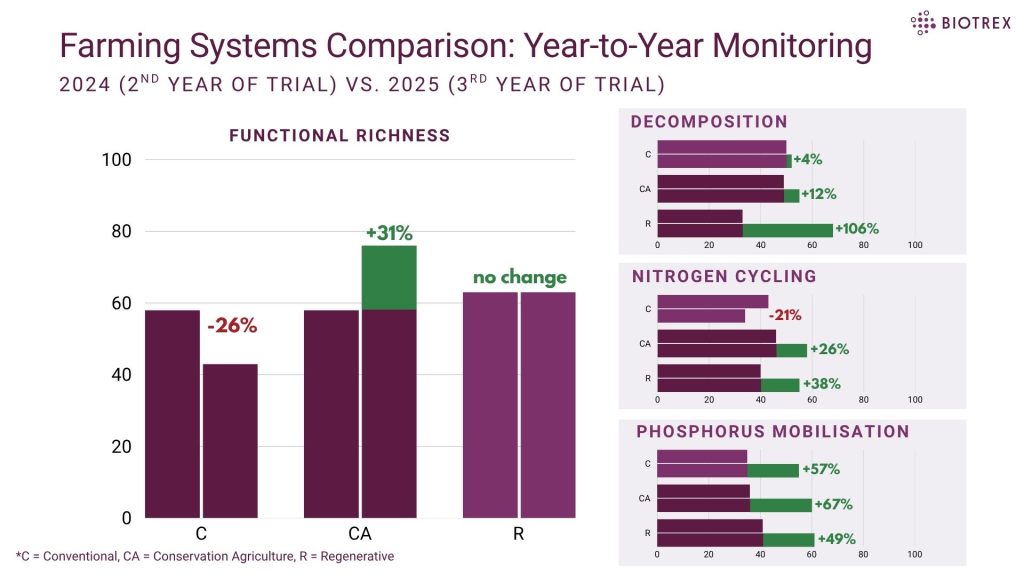
How these results should be interpreted? Let’s take a closer look at the Microbial Biodiversity indicator.
The Microbial Biodiversity reflects the combination of two biodiversity components: richness and evenness.
- The richness component describes how many different carbon sources the microbial community can utilize.
- The evenness component measures whether microbes use these substrates with similar intensity or if certain metabolic pathways dominate over others.
Both components are essential to assess the functional diversity and balance of the soil microbial community – key indicators of a healthy, resilient, and fertile soil ecosystem.
The relatively modest biodiversity scores in the Conservation Agriculture and regenerative agriculture fields reflect an expected transition phase. As soil management shifts toward lower disturbance and greater organic input, microbial communities undergo structural and functional reorganisation. Their biodiversity index being on a similar level to the conventional agriculture field is not a negative result; rather, it signals an ongoing transition toward balanced ecosystem.
Continued yearly monitoring is essential in order to confirm the long-term trend towards high biological activity and balanced diversity, which are the defining features of a resilient, fertile soil ecosystem.
Soil Microbial Testing in Your Field Trial
The results from this study confirm a pattern well known in soil ecology: the more the system supports natural processes, the more dynamic and functionally diverse its microbial community becomes. But the true value for companies running trials lies in how easily this can now be demonstrated.
Soil microbial life responds first to changes in management – long before visible differences appear. Monitoring these biological responses with BIOTREX gives you early, reliable signals of direction and effectiveness. Whether you’re testing a biostimulant, farming practice, or new crop management strategy, BIOTREX delivers the data you need to prove biological impact.
Quick Insight
Results are delivered quickly, allowing biological data to support seasonal decisions and progress reporting.
Easy Comparison
The standardised BIOTREX scale makes it possible to compare fields, treatments, or time points – even across different regions.
functional insight
Indicators reflect real ecosystem processes related to nutrient cycling and organic matter turnover.
Cost-Effective
Because BIOTREX focuses on activity and functional diversity of the whole microbial community, not full genomic sequencing, it offers high information value at a fraction of the cost.
About Norges Vel and Hellerund Farm
The Royal Norwegian Society for Development (Norges Vel) is an independent nonprofit organization founded in 1809 to strengthen Norway’s food self-sufficiency. Today, it promotes sustainable economic development, entrepreneurship, and innovation, both nationally and internationally. Its projects support local communities in Norway, Southern and Eastern Africa (including Mozambique, Tanzania, Kenya, and Madagascar), and Eastern Europe, helping to build independent, resilient enterprises.

The Royal Norwegian Society for Development (Norges Vel) is an independent nonprofit organization founded in 1809 to strengthen Norway’s food self-sufficiency. Today, it promotes sustainable economic development, entrepreneurship, and innovation, both nationally and internationally. Its projects support local communities in Norway, Southern and Eastern Africa (including Mozambique, Tanzania, Kenya, and Madagascar), and Eastern Europe, helping to build independent, resilient enterprises.
In Norway, Norges Vel operates Hellerud Farm in Lillestrøm municipality, one of the region’s largest agricultural properties. With 900 acres of farmland and 1,700 acres of forest, Hellerud serves as a development and research hub. Strategically located between Oslo, Lillestrøm, and Gardermoen, the farm provides an ideal setting for research, collaboration, and demonstration projects that connect science, practice, and community development.
The cooperation with BIOTREX at Hellerud Farm reflects Norges Vel’s commitment to integrating science-based tools that support sustainable agriculture and resilient rural communities.