

When Product Leaves the Lab and Enters the Field
Field trials are essential for demonstrating the effectiveness of microbial products under real agricultural conditions. However, unlike controlled laboratory or greenhouse experiments, field environments are highly dynamic and often unpredictable. This means that outcomes are often influenced by factors beyond the product itself.
As a result, inconclusive or highly variable trial outcomes do not necessarily indicate poor product performance. In many cases, they reflect environmental constraints that limit microbial processes or temporarily suppress biological activity at the time of sampling.
In this article, we outline the key soil and environmental factors that can influence microbial product trials and discuss practical strategies to reduce their impact.
Soil Conditions Can Limit Microbial Performance
Even well-designed microbial products depend on a minimum level of physical and chemical suitability in the soil. Conditions such as extreme pH, high salinity, low organic matter content, or compacted soil can severely limit microbial survival and activity, regardless of product quality.
In soils where structure restricts aeration, organic matter is scarce or poorly accessible, or chemical constraints dominate, introduced microorganisms may fail to establish or remain metabolically inactive. Under such conditions, biological inputs are often unable to express their intended function, not because they are ineffective, but because the soil environment does not support active microbial processes.
High Field Variability Can Mask Product Effects
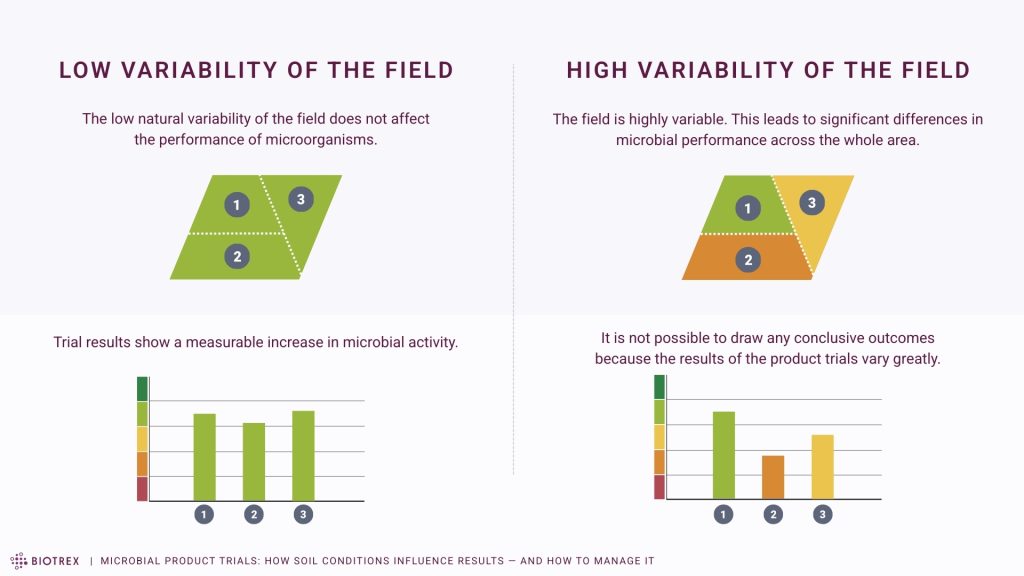
Field-scale variability is another major factor influencing trial outcomes. Differences in soil texture, moisture distribution, organic matter content, or historical management practices within a single field can lead to highly variable microbial responses.
When heterogeneity is high, even consistent product effects can be obscured by natural variation between samples. This often results in large error margins and inconclusive statistical outcomes, making it difficult to interpret whether the product truly influenced soil biology.
Weather Effects on Microbial Activity and Trial Results
Extreme or unfavourable weather conditions can strongly influence microbial activity in soil and, as a result, affect the outcome of product trials, regardless of the quality or formulation of the microbial inoculant.
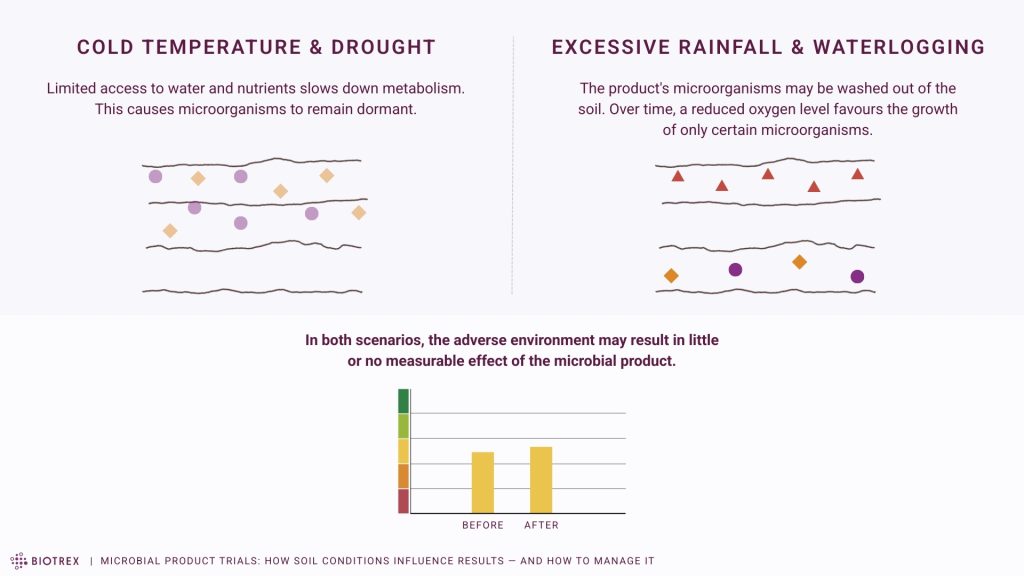
Cold temperatures and drought both limit microbial metabolism and mobility, reducing enzymatic activity and access to dissolved substrates. Under these conditions, introduced microorganisms may survive but remain largely inactive, entering dormancy or forming spores, leading to little or no measurable effect at the time of sampling.
Excessive rainfall or waterlogging can physically displace applied microorganisms and drastically alter soil oxygen availability. Reduced oxygen levels favour only certain microbial groups and can suppress aerobic processes, while heavy rainfall may wash inoculants deeper into the soil profile or out of the sampled zone, disconnecting application from measurement.
Designing Trials That Account for Soil and Environmental Constraints
While soil and weather conditions cannot be fully controlled, their impact on trial outcomes can be reduced through informed planning and field selection.
Good practices to consider include:
- Assess key soil properties before trial establishment, including pH, organic matter content, structure, and compaction, to identify constraints that may limit microbial activity.
- Improve basic soil conditions prior to inoculation, for example by increasing organic matter inputs, reducing compaction, or correcting extreme pH, to create an environment more supportive of biological processes.
- Select trial fields with relatively uniform soil characteristics, or increase the number of replicates when variability cannot be avoided, to reduce the impact of spatial heterogeneity on results.
- Plan trials for periods with favourable weather conditions, such as warm and adequately moist soils, when microbial activity is naturally higher.
- Use microbial formulations adapted to expected stress conditions, or multi-species products that can tolerate a wider range of environmental stresses when trials must be conducted under challenging conditions.
- Include multiple sampling time points, particularly when weather conditions fluctuate, to avoid drawing conclusions from a single snapshot of microbial activity.
Understanding Product Performance in Real Soil Conditions
When microbial inoculants are applied in the field, they do not operate in isolation. They enter a living, highly dynamic ecosystem shaped by constantly changing physical, chemical, and biological conditions. In such environment, variability is not an exception but the norm.
Soil biology assessments, including activity-based approaches such as BIOTREX, provide a unique and essential window into this complexity by revealing the actual state of the soil microbial community. However, whether the product will successfully establish in soil depends on many factors. To interpret results meaningfully, they must be considered alongside information on soil properties, field history, and environmental conditions.
Looking at trial results in this broader context helps shift the conversation. Instead of asking simply whether a product worked or failed, it becomes possible to understand how soil conditions, timing, and environmental factors influenced what was observed.
Ready to explore how BIOTREX can support your goals?
Book a free call with our experts and discover the impact microbial data can have on your business.