
Field trials of microbial products require significant investment of time and resources. Yet despite this effort, results can sometimes come back inconclusive or underwhelming, leaving teams questioning what went wrong.
The first instinct is often to doubt the product itself. But in many cases, the issue lies elsewhere — not in product performance, but in how the trial was designed, executed, or interpreted.
Based on years of supporting field trials across different crops, soils, and climatic conditions, we have repeatedly seen the same pattern: many unclear or contradictory results are caused by methodological and technical issues that make interpretation difficult. Small decisions made during trial planning, sampling, or logistics can have a surprisingly large impact on whether meaningful conclusions can be drawn.
Below are some of the most common pitfalls we observe in practice, and why they matter so much for obtaining reliable, interpretable results.
Trial Design: The Foundation of Reliable Results
The trial design ultimately determines whether observed changes can be confidently attributed to a product or are simply part of natural field variability.
One of the most overlooked issues is the lack of information on the physical and chemical properties of the soil. It’s not just about having access to this data, but about truly understanding it, and how it can influence the outcome of the field trial. Without insight into parameters such as pH, texture, moisture, or organic matter, it is difficult to assess how variable the field is to begin with. As a result, it becomes challenging to determine whether observed biological changes are meaningful or simply reflect underlying heterogeneity.
This uncertainty is often compounded by insufficient number of samples. While some fields are relatively uniform, others can be highly heterogeneous, with microbial activity varying significantly even over short distances. If this variability is not properly assessed and accounted for, too few replicates may be used. As a result, natural variation can overshadow real treatment effects, leading to weak or inconclusive outcomes.
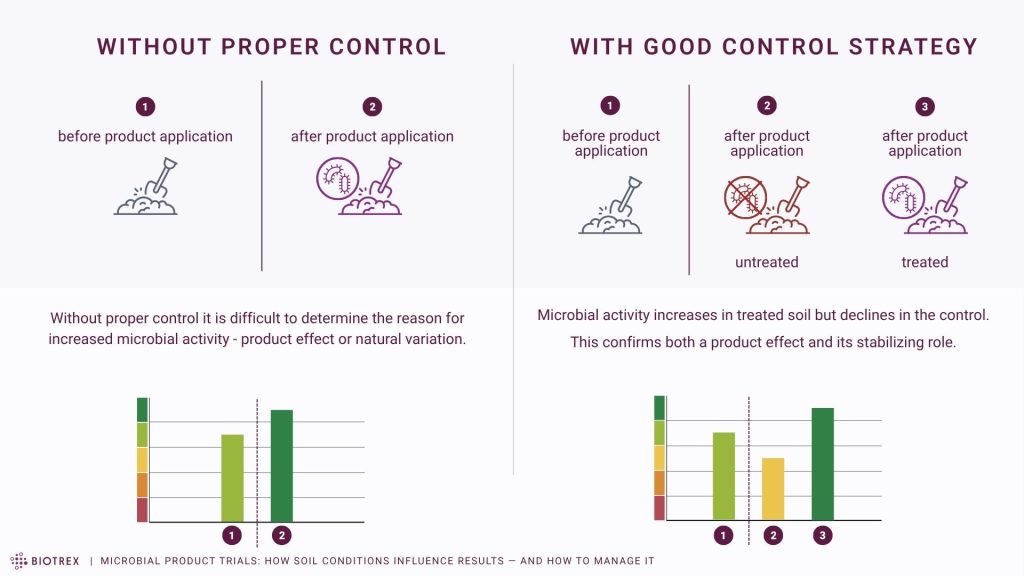
Another frequent issue is the lack of a proper control strategy. In practice, two types of reference points are essential.
The first is a baseline in time — a sample taken before product application. This establishes the starting point and allows changes to be tracked over the course of the trial.
The second is a control in space — an untreated area within the same field conditions. This enables direct comparison between treated and untreated soil.
Without this spatial control, it becomes difficult to determine whether observed changes are driven by the product or simply reflect natural fluctuations. Soil microbial communities are inherently dynamic, continuously responding to weather, plant development, and management practices. Without proper controls, any measured change lacks clear context.
Timing of Soil Sampling
Microbial products rarely produce immediate or permanent effects after just one application. Their impact is usually dynamic, temporary, and strongly influenced by environmental conditions. However, this does not mean that microbial products only work briefly after application or lack long-term value. While their activity is dynamic and influenced by conditions, consistent use can contribute to sustained improvements in soil processes and soil health.
Sampling too early may capture a moment when microorganisms have not yet established or become metabolically active. In such cases, results may suggest no effect simply because the biological response has not had time to develop.
Sampling too late presents a different challenge. Microbial activity often peaks shortly after application and then gradually declines as substrates are consumed or environmental conditions shift. This reflects changes in microbial activity rather than a complete loss of function. If sampling occurs after this peak, the strongest response may already have passed.
Relying on a single sampling time point adds another layer of risk. Microbial activity naturally fluctuates over time, and one measurement provides only a snapshot rather than a trend.
Soil Sampling Technique
Soil analysis never describes an entire field — it reflects the biological state of the soil sample that was collected. That simple fact makes sampling technique one of the most decisive factors determining whether results are meaningful or misleading.
One of the most common issues is inconsistent sampling depth. Microbial activity changes significantly with depth, especially between the biologically active topsoil and deeper layers, and even small deviations can introduce substantial variability.
In addition, when crops are present, roots add another layer of complexity. Soil close to roots is typically much more biologically active than bulk soil. For this reason, it should be defined in advance whether the trial aims to assess bulk soil or rhizosphere, and the same approach must be applied consistently across all samples to avoid misleading variability.
Another frequent problem is insufficient subsampling. When too few subsamples are collected, results are more likely to reflect local anomalies rather than the overall biological activity of the field. In heterogeneous soils, this often leads to very large variability between samples, making the results statistically weak or even impossible to interpret reliably. Similarly, collecting soil from unrepresentative areas, such as field edges, compacted zones, or visually distinct patches, can distort results.
Storage and Transportation: Changes Continue After Sampling
A critical risk, which is often underestimated, begins after the soil has already been collected. Soil remains biologically active, and microbial processes continue during storage and transportation.
In practice, many issues arise from seemingly reasonable handling decisions. For example, freezing samples may appear to be a good way to preserve them, but the freezing and thawing cycle can significantly disrupt microbial communities and alter their activity. Heat exposure is another common problem — samples left in the boot of a car, even for a short time on a sunny day, can quickly reach temperatures high enough to trigger rapid biological changes. Improper sealing can also cause issues, as open sample bags allow soil to dry out, which strongly affects microbial activity.
Because activity-based analyses measure what microorganisms are doing at the moment of testing, any changes during transport can mean the results no longer reflect the biological state of the soil at the time of sampling.
Delays in shipment are particularly problematic. Even samples that have been collected properly may become biologically altered if they are transported for too long or stored in unfavourable conditions.
Good Practices to Avoid Inconclusive Trial Results
To reduce uncertainty and generate results you can trust, a few key principles should always be considered:
Design and control samples
- Include an untreated control.
- Ensure sufficient replication to capture field variability.
- Collect samples before application (baseline) and after treatment.
- Consider multiple time points to capture microbial dynamics over time.
Field context
- Document initial soil conditions (e.g. pH, moisture, organic matter).
- Monitor key environmental and management factors throughout the trial.
Sampling strategy
- Follow a consistent and standardized sampling protocol.
- Take enough subsamples from representative areas (rhizosphere or bulk soil).
- Sample at the appropriate depth (e.g. 0–20 cm).
Sample handling
- Keep samples cool (but not frozen) and sealed.
- Avoid heat and direct sunlight.
- Ship samples as soon as possible after collection.
- Avoid sampling just before weekends or public holidays.
Ensuring Your Effort Leads to Clear Results
Ultimately, there is no single universal trial design or sampling strategy that fits every microbial product. The right methodological choices always depend on the specific product, its mode of action, and the goals of the trial. However, unlike soil biology or weather, these are the factors we can control.
That is why they should be planned strategically and always considered in the broader context of field conditions, including soil biological, chemical and physical properties, management history, and climate conditions.
When technical and methodological decisions are aligned with this wider context, trials are far more likely to produce results that are not only measurable, but also meaningful and truly informative for decision-making.
Ready to explore how BIOTREX can support your goals?
Book a free call with our experts and discover the impact microbial data can have on your business.